_By Matthew Sexton, LCSW, NATC, practicing clinician in private practice. Published July 25, 2026._
Across roughly 451 million in-network claims submitted on HealthCare.gov in 2024, only 5% of denials were for medical necessity, while 25% were administrative and another 9% were for a missing prior authorization or referral (KFF, March 24, 2026). That breakdown changes where a solo practice should be spending its billing time. The machine is mostly not arguing with your clinical judgment. It is mostly rejecting your paperwork.
So the most valuable minute in your billing week comes before you hit submit. That is also the part where the marketing gets loudest and the evidence gets thinnest, so here is the inventory: what pre-submission automation does, what it cannot do, and what the 2025 and 2026 data supports.
The shape of it:
- Automatable: eligibility and active-coverage checks, member ID accuracy, coding and modifier validation, place-of-service and telehealth indicators, timely-filing tracking, field-level scrubbing.
- Not automatable: medical necessity, appeal argumentation, and the note itself.
The denial mix is mostly clerical, and the carrier spread is enormous
Start with the base rate. Across 157 reporting insurers on HealthCare.gov in 2024, the average in-network denial rate was 19%, unchanged from 2023. Out-of-network claims were denied at 37% (KFF, March 24, 2026).
The average hides the useful information. Individual insurer in-network denial rates ran from 3% to 36%. Among parent companies receiving more than 5 million claims that year, KFF's Table 1 puts Elevance Health at 8% and Oscar Health at 25%. Same dataset, same year, roughly a threefold difference in how often a claim comes back rejected. If your panel skews toward the high end of that range, your billing workload reflects your payer mix more than your accuracy.
Now the reasons. KFF's 2024 breakdown: 36% unspecified "other," 25% administrative, 13% service exclusions, 9% lack of prior authorization or referral, and 5% medical necessity.
Five percent. The clinical judgment you spent years training for is the smallest named category on the list. What actually gets claims kicked back is field-level: coverage that wasn't active on the date of service, a member ID transposed by a digit, a modifier that didn't match the place of service, a filing window that closed.
Our arithmetic on KFF's shares: among denials that named a reason, clerical beats clinical 6.8 to 1
What follows is our arithmetic, not KFF's. Set aside the 36% KFF files as unspecified "other" and look only at the denials that came with a stated reason. That leaves 64 of the original 100 points. Administrative (25) plus prior authorization or referral (9) is 34 of those 64, or 53%. Medical necessity, 5 of 64, is 8%. Divide 34 by 5 and the ratio is 6.8 to 1: among 2024 marketplace denials that actually told you why, clerical reasons outnumbered clinical ones 6.8 to 1 on our reading of KFF's shares.
That ratio is ours, not KFF's. It is arithmetic (34 ÷ 64, 5 ÷ 64, 34 ÷ 5) run on KFF's published reason shares from March 24, 2026, and it rests on three assumptions worth stating rather than burying. One, the unspecified 36% is excluded because KFF does not say what sits in it; if that bucket is mostly clerical, the ratio understates the case. Two, counting the whole prior-auth slice as clerical is generous, since the requirement is checkable in advance but the payer's decision is not. Three, a national marketplace mix is not your panel. Run the same two divisions on your own denial log and you get your number instead of the country's.
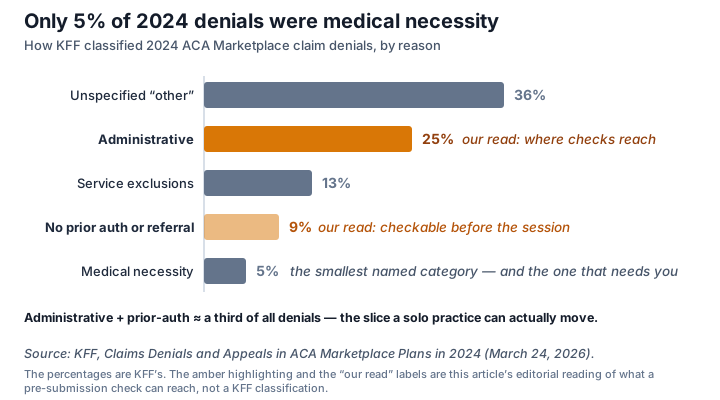
Administrative plus prior-auth is roughly a third of all denials, the slice a solo practice can actually move. Source: KFF, Claims Denials and Appeals in ACA Marketplace Plans in 2024 (March 24, 2026). The amber highlighting and its labels are this article's reading of what a pre-submission check can reach, not a KFF classification.
2024 marketplace denials by reason, and which ones a pre-submission check can reach
| Reason given | Share of 2024 denials | Can a pre-submission check reach it? |
|---|---|---|
| Unspecified "other" | 36% | Unknown — KFF does not specify what sits in this bucket |
| Administrative | 25% | Yes — eligibility, member ID, codes and modifiers, place of service, field completeness |
| Service exclusions | 13% | Not addressed here |
| Lack of prior authorization or referral | 9% | Partly — the requirement itself is checkable before the session |
| Medical necessity | 5% | No — clinical judgment, and it stays yours |
Source: KFF, Claims Denials and Appeals in ACA Marketplace Plans in 2024 (March 24, 2026). The right-hand column is this article's reading of what pre-submission checking can and cannot touch, not a KFF classification.
A read from the revenue-cycle side lands in the same place. In a survey of 250 healthcare financial, billing, and claims-management decision-makers, 50% named missing or inaccurate data as the top contributor to denials, up from 46% in 2024, and 68% said submitting clean claims is harder than a year ago (Experian Health, September 22, 2025). That sample skews toward hospital staff, so treat it as directional. The direction matches KFF.
Why appealing is not where a solo practice wins
Fair objection here. Denials get appealed, so why obsess over prevention?
Because almost nobody appeals, and appeals mostly lose. Fewer than 1% of denied in-network claims were appealed internally in 2024, across the entire individual market, and insurers upheld 66% of their original denials on the appeals that were filed (KFF, March 24, 2026). Denials go unappealed because the appeal path costs more time than most people can spend, and the ones who spend it lose two out of three.
None of which means don't appeal. Appeal the ones worth appealing, and appeal them well; we wrote the process out in how to appeal an insurance claim denial as a therapist, and the documentation angle is in what to document when a mental health claim is denied. But if you're deciding where to put a finite hour, the arithmetic points forward. The back end is where a hospital with a denial-management team wins. The front end is where you do.
The back end is where a hospital with a denial-management team wins. The front end is where you do.
— Matthew Sexton, LCSW, NATC
What actually gets automated before the claim goes out
The honest list is shorter than the sales page. Everything below is deterministic (a rule, a lookup, a comparison), which is why software handles it well and a tired human at 9pm handles it badly.
Eligibility and benefits verification
The check that runs before the session, not after the denial. Is coverage active on this date of service, is behavioral health carved out to a separate vendor, does the member ID match the payer's record, and what are the deductible status, visit limit, and referral requirement?
MGMA's practice data names patient eligibility and incorrect ID numbers among the causes group practices cite for denied claims, alongside insufficient documentation, untimely filing, and incorrect modifier usage (MGMA, March 6, 2024). Every item on that list except documentation is a data-matching problem. Automated eligibility runs the check on everyone on your calendar every morning, which no solo clinician does by hand and every solo clinician means to.
I do my own billing, and eligibility is the check I drop first when the day runs long. It is also the one that costs me the most weeks later, when the denial lands on a session I have already delivered and already forgotten the details of.
Coding, modifiers, and units
The category that generates the most rework. MGMA's practices specifically flagged incorrect modifier usage, particularly Modifier 25, as a denial driver. Behavioral health has its own version: session length versus the code billed, add-on codes that require a specific base code, interactive complexity applied where it doesn't belong, units that don't reconcile with documented time. The code-by-code rules are their own subject, and we walked through them in the therapy CPT codes beyond 90837.
A rules engine compares the code set on the claim against the payer's edit rules and your note metadata, then flags mismatches before submission: arithmetic and a lookup table, run at a consistency no person sustains across a full caseload.
Place of service and telehealth indicators
Telehealth turned a formerly boring field into a recurring denial source. Place-of-service codes, modifier requirements, and payer-specific telehealth rules shift on their own schedule, and they differ across the plans a single tri-state practice bills. A pre-submission check that validates the place-of-service and modifier combination against that payer's current rule catches the error while it's still free. The 2026 changes are their own subject, covered in telehealth billing changes for 2026.
Clean-claim scrubbing
The last pass before submission. Required fields populated, NPI and taxonomy correct, diagnosis pointers valid, dates coherent, timely-filing window still open. That last one varies more by payer than most people expect, and we put the windows side by side in timely filing deadlines by payer. All of it is mechanical, and it is the step most solo practices skip because there's no one to do it. Worth noting what the industry automates here: most medical group practices reported having 40% or less of revenue-cycle operations automated (MGMA, March 6, 2024). A solo practice adopting pre-submission checks is ahead of most of the field.
What does not get automated, and should not
Three things stay on your side of the line.
Medical necessity is a clinical judgment. It's 5% of denials by KFF's count, and it's the 5% that requires you. No pre-submission tool decides whether treatment was warranted, and a product implying otherwise is describing something you should not want.
Appeal reasoning is argument, not data validation. Software can assemble the packet, track the deadline, and pull the record. Constructing a clinical rationale against a payer's criteria is yours.
The clinical record is yours, full stop. Automation should make a claim consistent with what you wrote, never the reverse.
There's a hard-headed reason to accept that boundary. In a survey of 1,000 practicing physicians, only 24% said medical-necessity denials are consistently conducted by appropriately qualified clinicians, and prior authorization consumed an average of 13 hours of physician and staff time each week (AMA, press release May 13, 2026, survey fielded 2025). Those are physicians, not therapists, so read them as the burden ceiling across medicine rather than as your numbers. The lesson transfers anyway: fighting on medical-necessity ground is expensive even for practices with staff dedicated to it, and winning on clerical ground is cheap and available to you this week.
What the automation evidence actually supports
The one recent number on automation's effect: 67% of providers believe AI can improve the claims process, but only 14% currently use AI solutions. Among that 14%, 69% report that AI reduced denials or increased resubmission success (Experian Health, September 22, 2025).
The caveats matter as much as the figure. That 69% is self-reported by the people who bought the tools, in a vendor-run survey whose respondents skew toward large health systems rather than solo practices, so nobody should quote it as "AI reduces denials by 69%." What it supports is narrower: among early adopters the reported direction is favorable, and adoption is low enough to still be an edge.
Industry-wide numbers are firmer. The 2025 CAQH Index found U.S. healthcare avoided an estimated $258 billion in administrative costs in 2024 through electronic transactions and better data exchange, with a remaining $21 billion opportunity from fully automating transactions still done manually. 25% of provider organizations now use AI tools in administrative workflows (CAQH Index 2025 via DataSpring, February 19, 2026). That remaining $21 billion sits in steps still done by hand.
This section is short on dollar figures for a reason. The most-repeated cost-per-denial-rework statistic in billing content, credited in a dozen vendor blogs to the same association, traces back to an article that now returns a 404, so it does not appear above. Same for the widely quoted clean-claim-rate benchmark, and for every behavioral-health-specific denial-rate comparison we chased, all of which dead-ended in EHR vendor blogs.
The verified case for pre-submission work holds up without any of that: 25% administrative plus 9% prior-auth denials, under 1% appealed, 66% of appeals upheld.
Ten hours a month, and where they go
In Heard's fourth annual survey of 1,950 therapists across all 50 states and D.C., 86% of them solo practitioners, respondents reported about 10 hours per month on business admin, roughly 120 hours a year. 73.9% said compliance and paperwork consume the most time, 38% named insurance billing and claims specifically as a business headache, and 74.6% accept insurance (Heard's own survey of its audience, 2026). That's a vendor surveying therapists who already use accounting software, so read it as a floor.
Three work weeks a year, most of it clerical. Hours on eligibility checks, resubmissions, and portal logins produce nothing clinical and nothing billable. Whether you buy those hours back with software or with a person is a real fork, and the hours are what you're purchasing either way.
Some denials were never yours to prevent
A post about doing your paperwork correctly can imply that correct paperwork is always enough to get paid. Sometimes it isn't.
In August 2025, a state insurance regulator announced fines of over $20 million against 22 insurers after market conduct examinations found more than 6,000 mental health parity violations. The named violation types include improper prior authorization requirements for services that did not require prior authorization and claims reprocessed after post-service medical necessity reviews with unclear triggering events (Georgia Office of the Commissioner of Insurance and Safety Fire, August 15, 2025). A follow-on action in January 2026 issued nearly $25 million in additional fines against 22 insurers (Georgia OCI, January 12, 2026). We took that second action apart at length in what Georgia's parity fines mean for a practice.
Two honest framings. That's Georgia, not New York, New Jersey, or Connecticut, and neither press release names individual carriers, so it describes one state's market. And read the violation types again: a prior authorization demanded for a service that never required one is a denial no cleaner claim would have prevented. Clean submission clears the avoidable errors off your desk, which makes the unavoidable ones easier to spot and challenge.
A pre-submission routine that fits a solo practice
Practically, in the order the work happens:
- Verify eligibility before the session, on every client, every time. Active coverage, correct member ID, carve-out status, visit limits, referral requirements. Highest-yield automated check available, and it maps onto MGMA's named denial causes.
- Validate the code set against the note, not against memory. Session length, add-on codes, interactive complexity, units. Catch the mismatch when fixing it costs seconds.
- Confirm place of service and telehealth modifiers per payer. Per payer, not per practice. The rules diverge and they move.
- Run a field-level scrub on every claim. Required fields, identifiers, diagnosis pointers, dates, filing window.
- Track denial reasons by payer for 90 days. That means reading the remittance closely enough to categorize it, which is its own skill (how to read an EOB). A small number of recurring error types usually drive most of your rework. Fix those upstream and the volume drops without anyone appealing anything.
- Keep the appeal path for the denials that deserve it. Choose them deliberately instead of appealing on reflex.
Where VibeCheck.luxury fits
We build VibeCheck.luxury for the clinician who is also the billing department, which describes most practices reading this. Eligibility verification, code and modifier validation, place-of-service accuracy, a scrub before anything goes out. That is the category of deterministic work we think belongs in software instead of in your evenings, and it is the direction the product is built toward. Check the current feature list before you assume any specific piece of it ships today. Clinical judgment stays where it belongs either way.
The VibeCheck.luxury EMR is currently in beta. Pricing is not publicly listed; email [email protected] for more information.
FAQ
What percentage of claim denials can automation actually prevent?
There's no verified figure, and anyone quoting one is guessing. What the data supports: in 2024, 25% of ACA Marketplace denials were administrative and 9% were prior-auth or referral related, versus 5% for medical necessity (KFF, March 2026). That slice is what pre-submission checks address. How much of your own volume sits there depends on your payer mix.
Does AI billing automation reduce denials for a solo therapy practice?
The only recent number is soft. Among the 14% of providers using AI on claims, 69% reported that it reduced denials or improved resubmission success (Experian Health, September 2025). That is self-reported by adopters in a vendor survey weighted toward large health systems, so treat it as a favorable direction, not a measured effect.
What is the average claim denial rate?
Across 157 insurers and roughly 451 million in-network claims on HealthCare.gov in 2024, the average in-network denial rate was 19%, with carriers ranging from 3% to 36%. Out-of-network claims were denied at 37% (KFF, March 24, 2026). We found no verifiable behavioral-health-specific denial rate; the figures circulating on vendor blogs trace to no primary source.
What can't be automated in therapy billing?
Medical-necessity determination, appeal argumentation, and the clinical record itself, all of which require clinical reasoning about a specific client. Automation belongs on the deterministic layer: eligibility, identifiers, codes and modifiers, place of service, filing deadlines, field completeness.